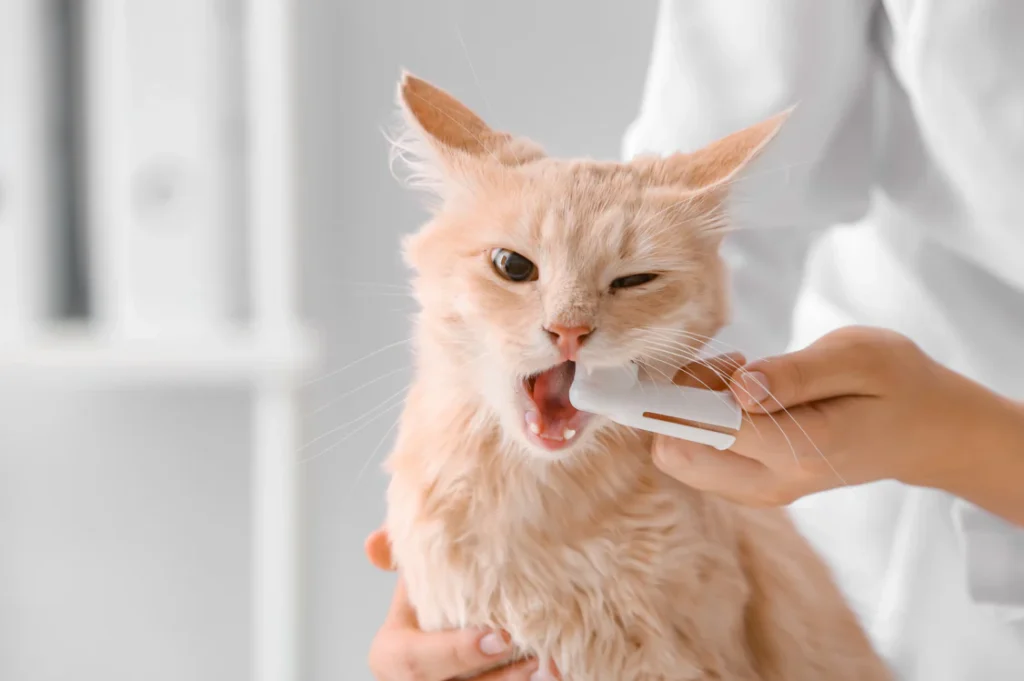
By the age of three, an estimated 70% of cats show signs of dental disease. By ten, the number is closer to 90%. Despite this, dental health remains the most consistently overlooked aspect of cat care — and in New York City, where veterinary access is excellent and dental care options are genuinely broad, there is no reason for it to be. This is what NYC cat owners need to know about feline dental health in 2026.
Why Cat Dental Disease Is Worse Than It Looks
Cats are extraordinarily good at hiding pain — a survival mechanism that means dental disease is typically far more advanced by the time an owner notices something is wrong. A cat with severe periodontal disease will often continue eating normally until the pain becomes impossible to compensate for.
The consequences of untreated dental disease extend well beyond the mouth. Bacteria from infected gum tissue enter the bloodstream and have been directly linked to kidney disease, heart valve infections, and liver disease in cats. Treating dental disease is not cosmetic maintenance — it is systemic disease prevention.
The Four Stages of Feline Dental Disease
Feline periodontal disease progresses in four stages, and the appropriate treatment changes significantly at each stage.
Stage 1 — Gingivitis: Gum inflammation without bone loss. Fully reversible with a professional cleaning and consistent home care. No permanent damage has occurred.
Stage 2 — Early periodontitis: Up to 25% bone and tissue loss around the tooth root. Professional cleaning under anaesthesia is required. Progression can be halted.
Stage 3 — Moderate periodontitis: 25–50% bone loss. Affected teeth may require extraction. Pain at this stage is significant even if the cat does not show it.
Stage 4 — Advanced periodontitis: More than 50% bone loss. Extraction of affected teeth is the primary treatment. Cats recover well from dental extractions — often eating better and behaving more energetically after removal of chronically painful teeth.
Signs Your Cat May Have Dental Disease
Because cats hide pain effectively, the signs of dental disease are often subtle. Any of the following warrant a dental exam:
- Bad breath — consistently foul or sharp odour that is not food-related
- Dropping food or chewing on one side — behavioural compensation for a painful tooth
- Reduced appetite or hesitation before eating — particularly with hard food
- Pawing at the mouth — intermittent pawing at the face or mouth area
- Visible tartar — brown or yellow buildup at the gum line, particularly on the upper back teeth
- Red or swollen gums — visible on examination when you lift the lip
- Excessive drooling — particularly if new or tinged with blood
- Behavioural changes — increased irritability, reduced grooming, or withdrawal from interaction
Lift your cat's lip and look at the gum line above the upper back teeth — this is where tartar and early gingivitis appear first. Pink gums with no visible buildup at the tooth base is what you are looking for. Red gums, brown deposits, or an unpleasant smell are reasons to book a dental exam.
Professional Dental Cleaning — What to Expect
Feline dental cleanings require general anaesthesia. There is no effective alternative — an awake cat cannot be safely or thoroughly examined, scaled, or treated. Anaesthesia-free dental cleaning services exist but are opposed by every major veterinary dental organisation because they provide no clinical benefit and create false reassurance.
A proper professional cleaning includes:
- Pre-anaesthetic bloodwork to confirm kidney and liver function
- Full mouth dental radiographs — 60% of feline dental disease is below the gum line and invisible without X-ray
- Ultrasonic scaling above and below the gum line
- Polishing to smooth enamel and reduce future plaque adhesion
- Extraction of non-viable teeth with appropriate pain management
- Post-procedure antibiotics and pain medication as indicated
In New York City, professional feline dental cleanings typically cost between $500 and $1,500 depending on the practice, the extent of disease found, and whether extractions are required. AAHA-accredited practices and feline specialty hospitals provide the most comprehensive dental care.
Home Dental Care — What Actually Works
Professional cleanings address existing disease. Home care slows the rate at which disease returns. The two are not interchangeable — but consistent home care can meaningfully extend the interval between professional cleanings.
Toothbrushing is the gold standard — daily brushing with a cat-specific toothpaste (never human toothpaste, which contains xylitol and fluoride toxic to cats) removes plaque before it mineralises into tartar. Introduce gradually over several weeks: toothpaste taste first, then finger contact on teeth, then a soft brush.
Dental treats and chews with the Veterinary Oral Health Council (VOHC) seal have clinical evidence supporting their plaque-reducing effect. Greenies, Purina Dentalife, and Hill's Prescription Diet t/d are among the VOHC-accepted options.
Water additives are the lowest-effort option with modest supporting evidence. VOHC-accepted additives add no detectable taste and go directly into the water bowl or fountain.
Dental diets — Hill's t/d and Royal Canin Dental — are formulated with a kibble texture that mechanically cleans teeth as the cat bites through it, rather than shattering immediately like standard kibble.
Tooth Resorption — A Separate and Painful Condition
Feline tooth resorption affects an estimated 30–40% of adult cats and is distinct from periodontal disease. The tooth structure is progressively destroyed from the inside — a process that is extremely painful and has no known prevention. Affected teeth cannot be saved and must be extracted.
The condition is diagnosed on dental radiograph — one of the reasons full-mouth X-rays during professional cleanings are essential rather than optional. Cats recovering from tooth resorption extractions consistently show improvement in behaviour, activity, and appetite, confirming the extent of pain the condition causes in cats who appeared to be managing normally.
If a dental cleaning does not include full-mouth radiographs, you are missing up to 60% of the disease picture. When booking a dental cleaning in NYC, confirm that dental radiographs are part of the standard procedure — not an optional add-on.
Find a Vet Who Prioritises Dental Health
Not all veterinary practices offer the same depth of dental care. AAHA-accredited practices are required to meet dental care standards as part of their accreditation. When evaluating a practice, ask specifically whether dental radiographs are included in cleanings, and whether the practice has digital dental X-ray equipment on-site.
For cats with advanced dental disease or complex cases, board-certified veterinary dentists practise in and around New York City and accept referrals from primary care vets.
Find a trusted feline vet: Veterinarians — NYC Directory across all five boroughs.
Verified veterinary practices across Manhattan, Brooklyn, Queens, the Bronx, and Staten Island — including AAHA-accredited practices and feline specialty hospitals.
Find a Vet Near You →